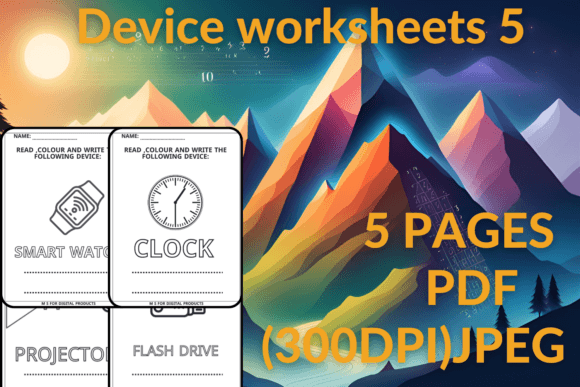
Device Worksheets 5 and Coloring Worksheets: A Strategic Tool for Early Learning and Cognitive Development
In a world filled with screens, notifications, and digital interfaces, helping young children understand their surroundings can feel both urgent and challenging. Parents and educators are increasingly looking for practical, grounded methods to introduce modern devices without overwhelming a child’s natural curiosity. Device Worksheets 5, coloring Worksheets offers a thoughtful approach: a set of printable activities that combine device recognition with the calming, focus-building practice of coloring. This isn’t just busywork—it’s a deliberate tool for building foundational awareness and cognitive skills in early learners.
For anyone guiding a child’s early development—whether you’re a parent, a homeschool educator, a preschool teacher, or a content creator developing learning materials—understanding how to use these worksheets strategically can make the difference between random activity and meaningful progress. This article explores what this resource offers, why it matters for learning outcomes, and how to integrate it into a broader plan for helping kids make sense of the devices that surround them every day.
What Device Worksheets 5, Coloring Worksheets Actually Provides
At its core, this resource is a curated set of five high-quality pages designed to help children identify and think about common modern devices—such as tablets, smartphones, laptops, and other household electronics—through coloring and simple worksheet prompts. The ZIP file includes both PDF and JPEG formats, with each JPEG rendered at 300 DPI for crisp, print-friendly results. The structure is simple: each page focuses on a different device or context, inviting children to engage visually and manually with the subject.
What makes this strategically useful, rather than just another printable, is its dual focus. It simultaneously asks children to recognize a device (building vocabulary and environmental awareness) and to engage in a fine-motor, creative task (coloring). This combination supports cognitive integration: the child is not passively looking at an image but actively processing and personalizing it.
For educators and parents, the real value lies in the intentional design. The worksheets are not cluttered or overly complex. They leave room for conversation, for questions, and for the adult to guide the child toward deeper understanding. When used thoughtfully, this simple resource becomes a springboard for discussions about technology, purpose, and context.
Strategic Use Cases for Different Audiences
- Homeschooling parents can incorporate these worksheets into a weekly theme about technology or community helpers (e.g., “the devices we use every day”).
- Preschool and kindergarten teachers can use them as part of a center-based activity or a quiet-time task that also builds device vocabulary.
- Childcare providers might print several sets to have on hand for transition times or group discussions about screen use.
- Content creators and bloggers focused on early childhood education can share these as a freebie or lead magnet, demonstrating a practical, low-hype approach to device literacy.
- Freelance curriculum designers can adapt the format as a model for creating their own themed worksheet sets.
Each use case benefits from a clear goal: what do you want the child to walk away with? For some, it might be the name of five devices. For others, it might be the understanding that devices serve different purposes. The worksheet doesn’t teach that on its own—it’s the conversation around it that matters.
How to Use These Worksheets for Real Learning Outcomes
Effectiveness depends on context, not just content. Handing a child a worksheet without connection to their real-world experience limits its impact. Instead, consider these planning tips to maximize the strategic value of Device Worksheets 5, coloring Worksheets:
Pair with Real Objects
Before or after coloring, show the child the actual device. Let them see the tablet, touch the keyboard, or press a button on the remote (with supervision). The worksheet becomes a visual anchor for a tangible experience. This pairing of real-world exposure with paper-based reflection strengthens memory and conceptual understanding.
Use as a Conversation Starter
Instead of simply instructing the child to color, ask open-ended questions: “What does this device do?” “Why do we use it at home?” “What would we do without it?” These prompts turn a coloring activity into a language-rich interaction. For young children, the labeling and coloring are secondary to the dialogue. For older preschoolers, you can extend this into sorting activities—grouping devices by function or by where they are found in the house.
Incorporate Into Routines, Not Random Moments
The best learning happens when it feels natural. Consider using one worksheet per day as part of a morning routine or after a meal. Spacing out the five pages over a week allows for reflection and recall. On the sixth day, you might review all five devices by asking the child to name each without looking at the worksheet. This simple retrieval practice builds long-term memory far more effectively than cramming.
Build a Review Habit
As the product description notes, “your review is important to improve our products.” This is not just a polite request—it’s an invitation to provide feedback that can refine future content. If you find a worksheet confusing or notice the child struggles with a particular image, sharing that observation helps creators adjust. This is especially relevant for educators and parents who want to see more targeted resources in the future.
What to Consider Before Using Device Worksheets
No single resource works in every context. Before committing to these worksheets, it’s worth assessing whether they align with your goals, your child’s developmental stage, and your overall approach to learning.
Developmental Appropriateness
These worksheets are designed for early childhood—roughly ages 3 to 6. If the child is younger, the coloring may be too complex, or the device images may not yet be meaningful. If older, the content may feel too basic, unless used as a quick warm-up or a conversation prompt about responsible device use. Always preview the pages yourself before introducing them. You know your child or students best.
Relying on Worksheets Alone
A common risk in early learning is over-reliance on printed materials at the expense of hands-on, exploratory play. Worksheets are best used as one component of a broader learning environment—not the centerpiece. If a child spends more time coloring tablets on paper than exploring real objects, the learning becomes abstract without context. Use these worksheets to supplement, not replace, direct experience.
Screen-Time Messaging
Because the worksheets focus on devices, you need to be mindful of the implicit message. For young children, devices are tools, not toys. The conversation around the worksheet should highlight purpose and function, not just appearance. Avoid framing devices as inherently “fun” or “entertaining.” Instead, talk about how each device helps people work, communicate, or learn. This sets a balanced foundation for future screen use.
The Cognitive Benefits Beyond Device Recognition
While the obvious goal is teaching kids about their tech-filled world, the deeper value of Device Worksheets 5, coloring Worksheets lies in the cognitive processes it supports. Children are not merely labeling devices—they are practicing:
- Visual discrimination: distinguishing one device from another by shape, size, and detail.
- Fine-motor coordination: coloring within or near lines builds hand strength and control.
- Attention and focus: completing a single page requires sustained engagement, which is a trainable skill.
- Categorization and reasoning: when guided by an adult, children begin to group devices by function (“things with screens,” “things that make sound”).
- Language and vocabulary: hearing and repeating device names in context builds expressive and receptive language.
These are not trivial outcomes. In an age of fragmented attention, any tool that helps a young child practice sustained focus and categorization is worth considering. The coloring aspect is especially valuable because it lowers cognitive load—children can process new information while their hands are busy, making the learning feel less pressured.
When to Use This Resource for Maximum Impact
Timing matters. Consider using these worksheets during:
- Transition periods: When moving from high-energy play to a quieter activity, coloring offers a calming bridge.
- Theme-based learning weeks: If your curriculum includes a unit on “technology in our lives,” these pages fit naturally.
- One-on-one time: Use them as a focused interaction with a single child, allowing for deeper conversation.
- Morning baskets or independent work: For slightly older preschoolers, a single worksheet can be part of a morning routine that builds self-direction.
- Travel or waiting times: Printed and tucked into a bag, these pages provide a low-screen activity that still engages the mind.
A Strategic Observation for Educators and Creators
If you are creating or curating learning materials, the model behind this resource is worth studying. It is simple, visually clear, and leaves room for adult facilitation. It does not try to teach everything at once. That restraint is a strength. In a market full of overcomplicated educational products, there is a real need for tools that respect the child’s pace and the adult’s ability to adapt. The 300 DPI JPEGs and PDF format also reflect a practical awareness: users want flexibility to print at different sizes or integrate pages into digital presentations.
For small business owners or bloggers in the early education space, offering a resource like this—either free or as a low-cost product—can build trust with an audience that values substance over flash. The key is to pair the download with guidance: a blog post or video showing how to use the worksheets conversationally, not just as coloring pages. That is where strategic value multiplies.
Final Practical Guidance
Using Device Worksheets 5, coloring Worksheets effectively comes down to intention. Before printing, ask yourself: What is my goal here? Is it to teach the names of devices? To build fine-motor skills? To spark a conversation about technology? To provide a calm, focused activity? Once you clarify the purpose, you can adjust how you present the worksheet, what questions you ask, and whether you follow up with a hands-on experience.
There is nothing wrong with using a coloring worksheet simply for quiet time. But if you are investing in a child’s development, you want to get the most out of every resource. That means engaging with the content, not just handing it over. Reviewing the pages yourself ahead of time, thinking about vocabulary, and planning a brief follow-up conversation will compound the learning.
And yes, reviewing the product after using it is a small step that helps creators understand what works and what doesn’t. If you find that the images resonate well, or that a particular device is confusing, share that feedback. It shapes better resources for everyone. Thoughtful use, paired with thoughtful feedback, creates a cycle of improvement that benefits the entire learning community.