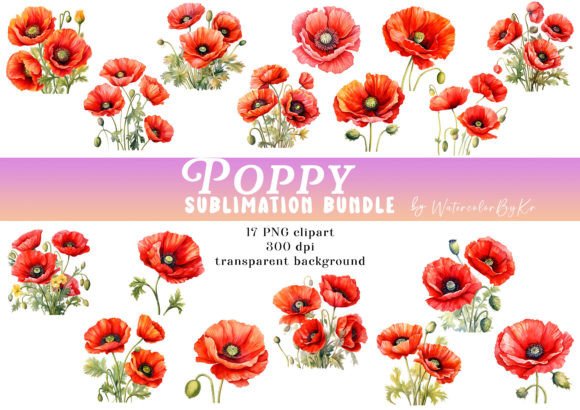
Watercolor Poppy Flower Bundle Clipart
Digital assets often serve as the invisible backbone of creative work. The right clipart set can transform a simple design into something cohesive and professional, while the wrong one adds friction, inconsistency, and extra hours of editing. Watercolor Poppy Flower Bundle Clipart sits squarely in the practical category—a resource designed for real projects, not just decorative inspiration. This collection of high-resolution, 300 DPI watercolor poppy illustrations offers versatile elements that integrate into print, digital, and product workflows without requiring extensive post-processing.
Whether you are a print-on-demand seller, a content creator building a visual library, or a small business owner preparing seasonal marketing materials, understanding how this bundle fits into a production pipeline is more useful than simply admiring its appearance. Let's break down what this file is, where it works best, and how to integrate it smoothly into your processes.
What Exactly Is This Bundle and Where Does It Fit?
Watercolor Poppy Flower Bundle Clipart is a digital download containing a set of hand-painted poppy illustrations in watercolor style. Each element is rendered at 300 DPI with transparent backgrounds, provided as PNG files. There is no watermark, no physical shipment, and no licensing restriction that limits how you can use the art across different mediums.
In a workflow context, this bundle operates as a source asset library. It is not a finished product in itself, but a component you pull into design software—whether that is Adobe Illustrator, Photoshop, Canva, Procreate, Affinity Designer, or a vector editing tool. The resolution and transparency remove the need for manual background removal or resolution scaling before placement. That means you can go directly from download to layout without a preparation step.
This type of asset is most useful during the assembly and composition phase of a project. After you have sketched a concept or defined a layout structure, you bring in these poppy elements as visual fill, focal points, or repeating patterns. They function similarly to a stock photo library, but with the distinct advantage of a unified aesthetic—watercolor texture, botanical subject matter, and consistent color treatment across all files.
Practical Use Cases Before, During, and After a Project
The flexibility of this bundle extends across multiple stages of a creative or business workflow. Here is how you might use it at different points in your process.
During the Planning and Mood Boarding Phase
Before you commit to a specific color palette or layout direction, you can drop these poppy elements into a mood board or concept sketch to test visual tone. Because the artwork is watercolor, it immediately communicates a soft, organic, and handcrafted feel. Place one or two PNGs into a simple board alongside typography samples and background textures. If the aesthetic aligns with your brand or project goal, you can move forward knowing the visual language is consistent.
This is particularly useful for marketers and small business owners planning seasonal campaigns—spring and summer product launches, Mother's Day promotions, garden-themed events, or botanical branding refreshes. Instead of searching for references across multiple platforms, you have a ready-made test asset that gives you an accurate sense of the final look.
During Active Design and Production
This is where the bundle pulls its weight. With high-resolution transparent PNGs, you can layer poppy flowers directly into existing compositions without extra masking. Consider these specific tasks:
- T-shirt and apparel mockups: Drop a single poppy or a cluster onto a garment template. The 300 DPI resolution ensures that the detail holds up at print scale, and the transparency means the fabric background shows through naturally.
- Greeting cards and invitations: Arrange multiple poppy elements along borders, corners, or as central illustrations. Because the files are separate, you can scale, rotate, and overlap them without breaking the composition.
- Nursery decor and wall art prints: Combine poppies with text or other botanical elements to create a printable poster. The layered PNG approach allows you to control placement precisely before exporting to a print-ready PDF.
- Mugs, stickers, and sublimation products: The watercolor style works well for sublimation because the soft edges and color gradients transfer smoothly onto coated surfaces. Use the PNGs directly in your sublimation design software without needing to recreate the watercolor effect from scratch.
For print-on-demand sellers, the lack of watermarks is a significant workflow advantage. You do not need to purchase a separate commercial license or spend time removing branding from the artwork. The file is ready for production output immediately after download.
After Production: Archiving and Repurposing
Once a project is complete, these assets do not sit idle. Because the bundle contains individual elements, you can archive them as part of a larger asset library for future use. Many creators and small business owners find that having a curated set of botanical clipart reduces the time spent searching for new visuals in subsequent projects. Over several months, you might use the same poppy element in a blog header, a product label, a sticker sheet, and a social media template—each time in a different context, but with a consistent visual thread.
How This Bundle Interacts With Tools and Platforms
Understanding compatibility is key to smooth implementation. The bundle's PNG format with transparent background is universally supported across design software. Here are some practical notes for common tools and workflows:
- Canva: Upload the PNGs to your Canva asset library. Because Canva handles transparency natively, you can drag poppies directly onto designs. Use the "background remover" tool if needed (though it should not be necessary) and adjust scale without quality loss thanks to the 300 DPI originals.
- Adobe Photoshop or Illustrator: Place the files as linked or embedded layers. The high resolution allows for significant scaling before pixelation becomes visible. In Illustrator, you can convert raster PNGs to vectors using Image Trace if you prefer editable paths, though the watercolor texture is best preserved in raster form.
- Procreate (iPad): Import the PNGs as layers. Use the alpha lock feature to recolor elements or add texture overlays while preserving transparency. This is useful for matching the poppies to a specific brand palette.
- Print-on-demand platforms (Printful, Printify, Redbubble, etc.): Upload the PNG directly as a design layer. Verify that the file dimensions match your product template, and that the resolution stays above 300 DPI at print size. The bundle's native resolution gives you room to upscale slightly if needed.
- Sublimation software (Sawgrass, CorelDRAW, etc.): Use the PNGs as-is. The watercolor style performs well with sublimation because the gradient transitions are smooth and do not rely on fine line work that might blur during transfer.
Practical Implementation Tips for Smooth Integration
Getting the most out of a clipart bundle is not about the art itself, but how you organize, test, and apply it within your routine. Consider these process-oriented steps.
Preparation and Organization
Before you start designing, create a dedicated folder structure for your digital assets. Separate the poppy bundle files into subfolders by element type—individual flowers, clusters, leaves, stems, and any decorative accents. Name each file descriptively so you can find specific elements quickly without opening every thumbnail. This upfront organization saves significant time when you are in the middle of a project and need a particular shape or color.
Usability and Quality Control
Test one or two elements in your intended design software before committing to a full layout. Check for the following:
- Does the transparency layer import correctly? Some software handles PNG transparency better than others. Confirm that no white halo appears around the edges.
- Is the resolution sufficient at your intended print or display size? Scale the element up to the maximum you plan to use. If the edges remain crisp and the watercolor texture does not pixelate, you are safe.
- Does the color profile match your output device? Most watercolor bundles are created in sRGB, which is fine for web and most print-on-demand services. If you are printing professionally, you may need to convert to CMYK and adjust saturation accordingly.
For sublimation, always test a small sample first. Watercolor styles often depend on semi-transparent layering, and the transfer process can sometimes shift colors or reduce contrast. A quick test run prevents waste.
Consistency Across Projects
If you use the bundle across multiple products—say, a sticker set, a mug design, and a greeting card—maintain visual consistency by sticking to the same color treatment and scaling logic. Do not resize one poppy to 200% and another to 50% unless you intend a clear hierarchy. Watercolor elements look best when their relative proportions remain natural. Also, keep a single source file (a master composition) where you place all the poppy elements you plan to use. From that master file, you can export variations for different products, ensuring that colors and placement stay consistent.
Long-Term Value and Asset Management
Digital downloads like this one are part of a larger shift toward asset-based workflows in both creative and commercial fields. Instead of commissioning custom illustrations for every project, you build a library of high-quality elements that can be remixed, reused, and repurposed. The Watercolor Poppy Flower Bundle Clipart is a good candidate for this approach because the subject matter (botanical, floral) is broadly applicable across seasons, industries, and design styles.
To maximize long-term value, treat the bundle as you would a tool—maintain it, version it, and use it deliberately. Keep the original ZIP file archived in cloud storage or an external drive. When you use an element in a project, note which file you used and where it appears in the final design. This becomes useful if you need to recreate a product later or adjust a color across a series of items.
Over time, you will develop a sense of which elements work best for specific contexts. The large, detailed poppy blooms might become your go-to for wall art and posters, while the smaller leaves and buds work better for stickers and accent details. That kind of familiarity only comes with repeated use, and it makes future projects faster and more intentional.
Final Observations on Workflow Integration
Watercolor Poppy Flower Bundle Clipart is not a tool in the traditional sense—it does not perform a function or automate a task. But in a practical workflow, it functions as a visual raw material that reduces the distance between concept and finished product. By eliminating the need to create watercolor textures from scratch, remove backgrounds, or search for consistent floral illustrations across multiple sources, it compresses the timeline from idea to output.
For entrepreneurs and creators who produce multiple products or pieces of content per month, that compression is meaningful. Even saving ten minutes per project adds up over a quarter. The bundle becomes part of your regular toolkit, not because it is flashy, but because it reliably fills a specific role in your process. That reliability—knowing the file will work, will be high-enough resolution, will have no watermarks, and will blend well with other assets—is what makes a digital download worth integrating into a busy workflow.
If you already have a clear idea of what you want to produce, this bundle gives you a direct path to execution. Organize your files, test the elements in your chosen software, and start layering them into your designs. The rest is simply repetition and refinement.